
Thoughts on the Ashes

The Downunder Ashes are over, and AUS has handed out the customary drubbing to ENG. It is the 18th time in Ashes history that AUS has won four Tests in a series. This time however, the circumstances were not regular. The 4-1 scoreline says that they were, but this was not an ultimate vanquishing by a side of the qualities of the Australian 2006-07 or 2017-18 vintages - nor was it a series where as well as strong home form, the away side was crushed by absurd C-19 regulation.
The truth is, in 2025-26 the home side was there for the taking, and ENG supporters had as much, if not greater, hope of success than at any time since the Ashes-holders left English shores in 2006-07. Whilst defeat has not been as crushing as back then, the result is similar, the record book shows 4-1, and in 40yrs time that’s all they’ll say.
In terms of both batting and bowling, Ben Stokes’s side departed with substantial confidence in their ‘brand’ of ‘attacking cricket’. Given that they didn’t feel they needed real, testing FC match practice, they clearly felt very positive about their chances of turning over an aging and injured squad that was not so much rebuilding, as shoring up for one last go together before rebuilding.

ENG were fully intent on pursuing their ‘Yosemite Sam Cricket’, the flamboyant over-expressive, charging, ass-kicking, volatile, hit or miss style that they have played since late-2022 when Ben Stokes and Brendon McCullum decided that sport was show business. We know what the press called it, and we know what former ENG players think of it - in particular two Yorkshire and England openers of different eras.
Like Yosemite Sam himself, ENG have had some success - spectacular success even at times against weaker opponents, I well recall Ben Stokes opening the batting at Edgbaston in 2024 and creaming the WIN attack. However, when they encounter a durable, more patient, more cerebral opponent, Bugs Bunny always wins and Sam ends up getting battered.
ENG’s approach on the field was one thing. Success was never guaranteed, but the chances of it working in Australia would have increased exponentially had - as discussed in the previous Ashes piece - ENG not fallen foul of a well-known and simple adage: ‘proper planning, preparation and practice prevents piss-ipoor performance’.
For starters, they did not seem to fully appreciate that in recent years the nature of Australian pitches had changed. Perhaps ENG thought that all they needed to do was pitch up with a pace barrage - Archer, Wood, Carse - and blow AUS away. In fact, whilst a strike bowlers or two are always useful, on these pitches, the skills of bowlers who are relentlessly accurate and seam it around were also required - as of course, was a competent spinner. In short, they needed Sir James Anderson and/or Chris Woakes - plus Graham Swann. Though the fact that ENG cricket has not produced a Graham Swann in the past 10-odd years, is not the fault of Key, MacCullum and Stokes.
This fundamental selection error was compounded by the fact that ENG deemed superfluous the notion of meaningful, testing match practice. Consequently, batsmen were not afforded opportunities to ‘get their eyes in’, bowlers would not develop rhythm and fielders practiced outside game conditions. One also questions how much attention they devoted to analysis of the AUS side, and to developing specific match strategies and tactics - which given the injuries to Hazlewood, Cummins and Lyon should have been quite simple;
“Look, with their injuries, there’s only Starc who can really hurt us, and he can get expensive if he’s not getting wickets. So we shall see him off, particularly his first 2-3 overs of each spell. Then there’s Boland, he’s strong and accurate, pay him respect, but don’t be afraid of him. As for the others, they feed off Starc - Neser, Doggett, Green - so if he doesn’t create momentum then they are probably not the ones to strike hard. Above all, remember this, they are all in their mid-30s, so take them deep, make them take a second new ball every innings”.
Yet, with no practice and no strategy, ENG went with their philosophy of all-out attack. In doing so they failed to respect their opponents and condemned themselves to failure, which in turn disrespected their travelling supporters - not the mention the ones stopping up all night to enjoy anticipated wins. ENG’s approach was the equivalent of Hitler ordering the invasion of USSR in June 1941, without issuing his troops with winter clothing and equipment.
In Perth, Starc bowled 24.1 overs in the match - this is what he should have been made to bowl in each innings; in Brisbane he bowled 38, in Adelaide 33, and in the fourth Test in Melbourne, just as he should have been feeling the effects of fatigue - or even inured - he bowled just 16 overs. Actually , a perfect work-out. Boland bowled 21.4 overs, 36, 33.2 and 18 respectively. Brainless ENG finally got it right in the last Test in Sydney, where Starc bowled more than 40 overs and Boland over 50……yet they still lost - because of their bad shots, dropped catches and wayward bowling.
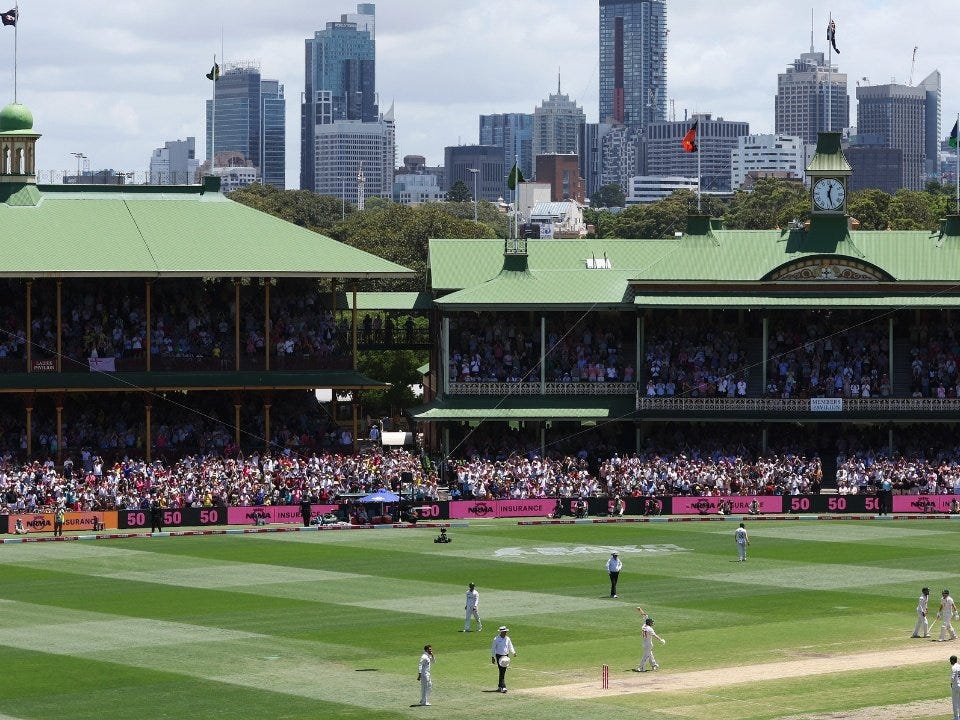
Sydney Cricket Ground - One of the Loveliest in the World
Your Author Was Born in 1966, of the 21 Ashes Tests at the SCG in His Lifetime, ENG Have Won 4 Only
Conversely, it is quite obvious that AUS made precise plans and were fully committed to doing all they could to ensure that they were ready for the fight. They were certainly committed to getting their players match fit. Before the Test series, in tough Sheffield Shield cricket, Lyon bowled 150 overs, Neser 114, Boland 91, Doggett 74, Starc 31 and Green, Webster and Labuschagne also turned their arms over a few dozen times. With the bat, Weatherald sealed his place in the squad with 67, 57, 94 and a few more besides; Labuschagne hit 160, 159 and 50; Khawaja 69, 46 and 87; Smith made 118, 57 and 56, and wicket-keeper Carey and the bowlers all got time at the crease. Only Head failed to make a decent score, but in the end it didn’t matter because ENG were kind enough to bowl him into form.
Effectively, when the teams arrived at Perth, all of the AUS squad were either in form or getting close to it. The bowlers certainly had overs in their legs - apart from Starc, who obviously knew just what his mind and body needed - and they were all focused.
ENG were walking through treacle, more concerned with mood than match readiness. How did they prepare? They played three one-dayers in NZ. They obviously wanted to develop ‘good habits’ for the Ashes, because in the first they were 10-4 after 5.1 overs, in the second they were 63-4 after 16.1 and in the third they were 44-5 after 10.1.
After arriving in Australia they played a gentle three-day game amongst themselves, and against second or third string bowlers, Crawley, Duckett and Pope made 82, 92 and 100 at strike-rates of 81, 94 and 88 respectively, and never had to graft for their runs.
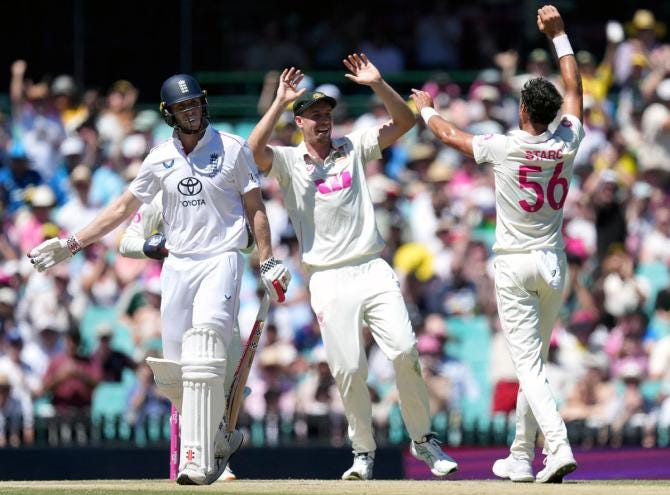
Zak Crawley Dismissed For Peanuts By Mitchell Starc in the First Over of the Innings……Again
Credit: Asanka Brendon Ratnayake/Reuters
BATTING
So much for the planning and preparation, what about what transpired on the field?
Commencing with the batting. Perhaps it is wrong to concentrate on, and condemn, the top-3, but we shall, because there is a very strong argument to be made that suggests ENG lost the series mainly because the top-3 had very limited stickability:
1st Test: 1st - 1-0, 33-2, 39-3, 94-4………….2nd - 1-0, 65-2, 76-3, 76-4
2nd Test: 1st - 5-1, 5-2, 122-3, 176-4………..2nd - 48-1, 90-2, 97-3, 121-4
3rd Test: 1st - 37-1, 41-2, 42-3, 71-4…………2nd - 4-1, 31-2, 109-3, 177-4
4th Test: 1st - 7-1, 8-2, 8-3, 16-4………………2nd - 51-1, 65-2, 112-3, 137-4
5th Test: 1st - 35-1, 51-1, 57-3, 226-4………..2nd - 4-1, 85-2, 117-3, 219-4
With scores of: 46, 33, 0, 26, 3 & 17, after Adelaide, Ollie Pope was dropped for Jacob Bethell who made: 1, 40, 10 & 154. This had to be done, Bethell is the future, but Pope’s career is not necessarily over.
It was a similar story for the openers, but let us not be damningly and blindly judgemental. We should put the series in context and look at how Crawley and Duckett did relative to the performances of ENG’s opening batsmen in previous series.
2010-11 - Won 3-1…………Av. Opening Partnership = 78.4 - 126.8 balls/21.1 overs
1st Test - D: Strauss 0 (0.3 overs), Cook 67 (65.3)…………..Strauss 110 (66.2), Cook 235*
2nd Test - W: Strauss 1 (1.3 overs), Cook 148 (96.4)………..n/a
3rd Test - L: Strauss 52 (31.3 overs), Cook 32 (24.1)……….Strauss 15 (9.5), Cook 13 (6.1)
4th Test - W: Strauss 69 (55.3 overs), Cook 82 (51.1)………n/a
5th Test - W: Strauss 60 (22.2 overs), Cook 189 (115.3)…..n/a
Series Av.: Strauss 43.5, Cook 127.66
2013-14 - Lost 5-0…………Av. Opening Partnership = 25 - 53.3 balls/8.5 overs
1st Test - L: Cook 13 (10.2 overs), Carberry 40 (36.3)…….Cook 65 (60.2), Carberry 0 (4.4)
2nd Test - L: Cook 3 (2.4 overs), Carberry 60 (45.6)………Cook 1 (1.3), Carberry 14 (11.4)
3rd Test - L: Cook 72 (48.4 overs), Carberry 43 (25.4)……Cook 0 (0.1), Carberry 31 (18.6)
4th Test - L: Cook 27 (16.5 overs), Carberry 38 (33.6)…….Cook 51 (21.3), Carberry 12 (27.5)
5th Test - L: Cook 60 (6.2 overs), Carberry 0 (3.3)………….Cook 7 (1.6), Carberry 43 (21.2)
Series Av.: Cook 24.6, Carberry 28.1
2017-18 - Lost 4-0…………Av. Opening Partnership = 21.4 - 41.7 balls/7 overs
1st Test - L: Cook 2 (2.4 overs), Stoneman 40 (54.2)…….Cook 7 (3.3), Stoneman 27 (27.4)
2nd Test - L: Cook 37 (28.1 overs), Stoneman 18 (6.6)…..Cook 16 (19.5), Stoneman 36 (23.3)
3rd Test - L: Cook 7 (4.4 overs), Stoneman 56 (37.5)…….Cook 14 (7.3), Stoneman 3 (1.5)
4th Test - D: Cook 244* (144.1 overs), Stoneman 15 (11.3)…..n/a
5th Test - L: Cook 35 (32.3 overs), Stoneman 24 (9.5)……Cook 10 (5.5), Stoneman 0 (1.5)
Series Av.: Cook 47, Stoneman 25.7
2021-22 - Lost 4-0…………Av. Opening Partnership = 18.3 runs - 39.9 balls/6.5 overs
1st Test - L: Burns 0 (0.1 overs), Hameed 25 (26.4)……..Hameed 27 (20.6), Burns 13 (8.6)
2nd Test - L: Hameed 6 (6.2 overs), Burns 4 (2.1)……….Burns 34 (30.6), Hameed 0 (1.6)
3rd Test - L: Hameed 0 (1.5 overs), Crawley 12 (7.2)…….Hameed 7 (10.3), Crawley 5 (4.4)
4th Test - D: Hameed 6 (9.2 overs), Crawley 18 (16.6)….Crawley 77 (32.6), Hameed 9 (19.2)
5th Test - L: Burns 0 (1.4 overs), Crawley 18 (7.6)………..Burns 26 (16.2), Crawley 36 (22.2)
Series Av.: Hameed 10, Burns 12.82, Crawley 27.66
2025-26 - Lost 4-1…………Av. Opening Partnership = 19.1 runs - 20.9 balls/3.48 overs
1st Test - L: Crawley 0 (0.6 overs), Duckett 21 (6.4)…….Crawley 0 (0.5), Duckett 28 (16.2)
2nd Test - L: Crawley 76 (27.5 overs), Duckett 0 (0.1)…..Crawley 44 (21.2), Duckett 15 (7.4)
3rd Test - L: Crawley 9 (7.4 overs), Duckett 29 (9.6)…….Crawley 85 (53.3), Duckett 4 (1.2)
4th Test - W: Crawley 5 (4.2 overs), Duckett 2 (2.3)...…..Crawley 37 (18.4), Duckett 34 (6.6)
5th Test - L: Crawley 16 (11.4 overs), Duckett 27 (6.5)…..Crawley 1 (0.5), Duckett 42 (19.1)
Series Av.: Crawley 27.3, Duckett 20.2
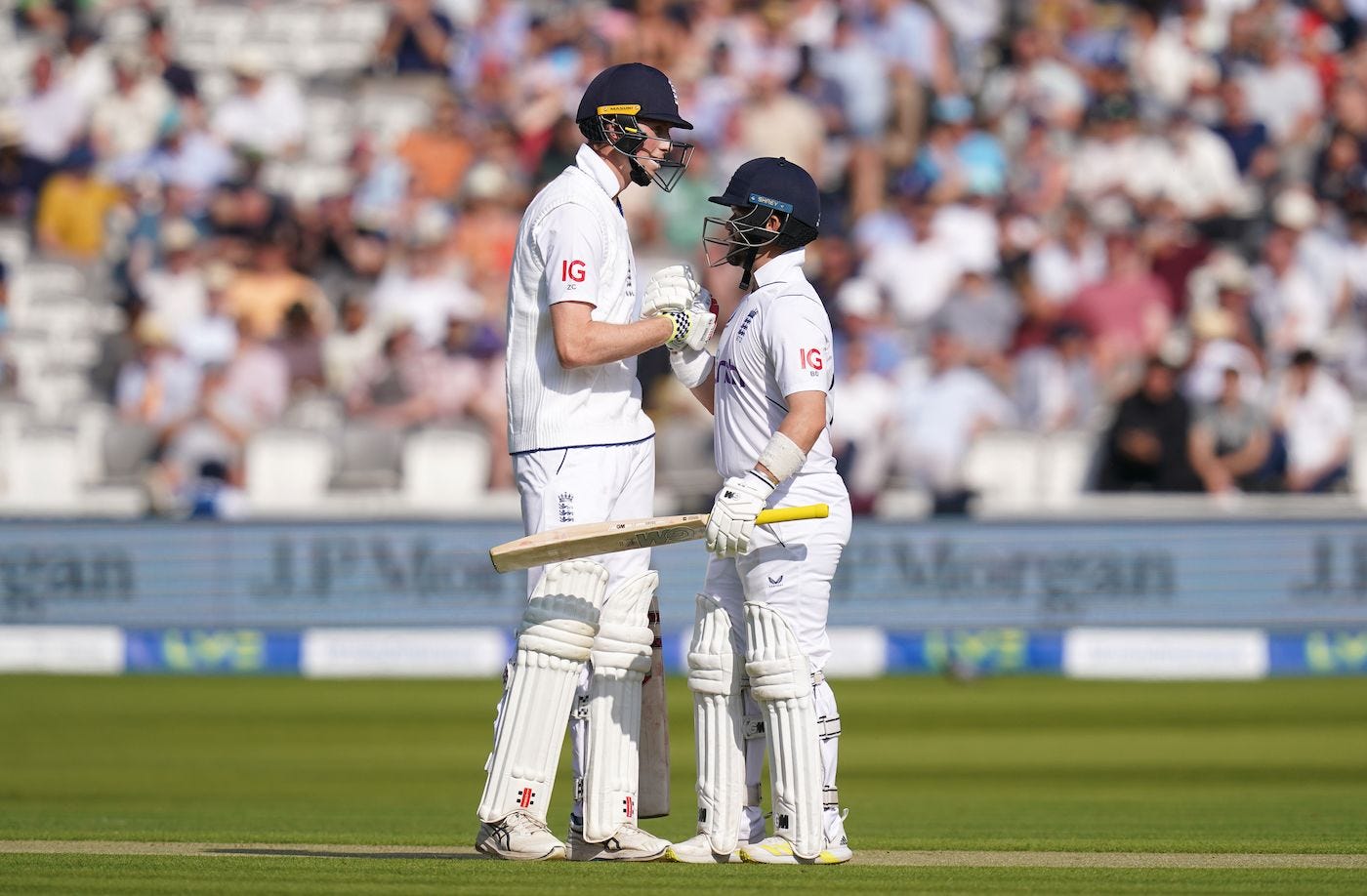
The evidence suggests that Crawley and Duckett performed on par with the openers of the previous three series - albeit they got out a good bit earlier. However, one must observe that, apart from Cook, they are much more talented than their immediate predecessors, so concomitantly, expectations were higher. [These figures also suggest that Michael Carberry, who never played for ENG again after the tour, was very much hard done by - why was he not persevered with for another summer1.]
Without delving too deeply into an analysis of those numbers, one element of winning a series in Australia is abundantly clear - it is imperative that the openers must graft to construct at least a 50+ partnership, and in doing so must stick around for at least 20 overs. Doing so would enable the ‘strike’ batsmen at 4, 5, 6 and perhaps 7 to arrive at the wicket without the need to fight fires, and without Labuschagne chirping wise-cracks. Opening partnerships that don’t last 10 overs create pressure that is too easily compounded - especially when it keeps happening Test after Test.
Thus, the most poignant question that arises in respect of Duckett and Crawley is, ‘should openers be considered strike batsmen’? Obviously, ENG think they should. Aesthetically, when they are on song, Crawley and Duckett are perhaps the most formidable partnership in the world. They play thrilling and beautiful shots. However, statistically, they are not, in any way, overwhelmingly successful. Outwardly their average partnership is 61.51; however, take two partnerships of 121 against IRE and 231 against ZIM out of the equation and the figure drops to 36.07. That is insufficient.
An alternative question might be, ‘should both openers be strike batsmen’? ENG have some thinking to do. One suggests that they cannot continue to open with both Crawley and Duckett, they are both gamblers who ‘twist on 17’ every time. See below for suggestions for a less mercurial batting line-up.
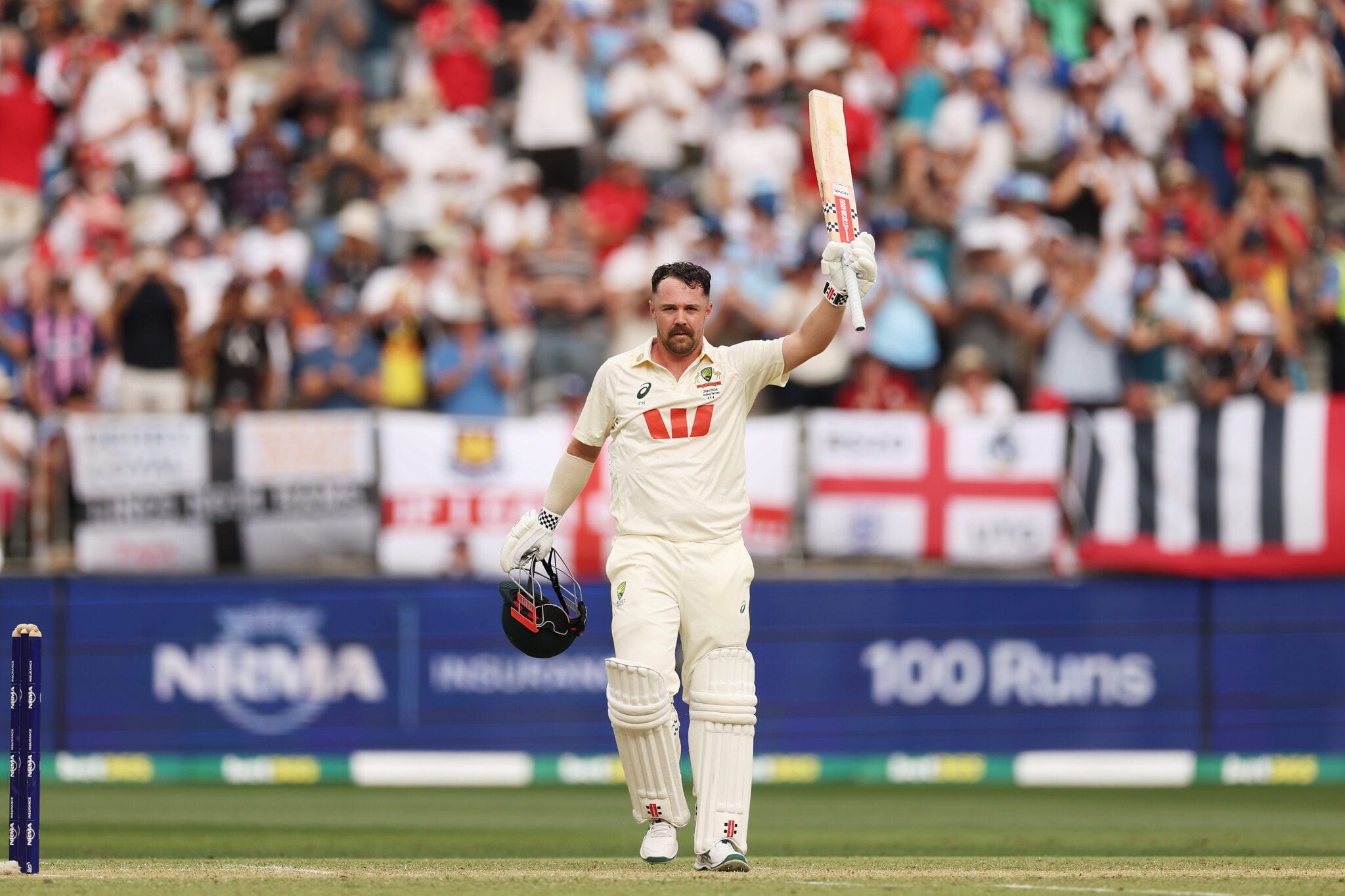
Travis Head - 629 Runs at 62.9 With 3 Hundreds - Flayed the ENG Bowlers Because They Bowled to His Strengths
BOWLING
ENG’s bowlers certainly lacked consistency. In the first innings at Perth the bowling was fiery, challenging and accurate; but as these figures2 show in the second innings it was anything but. These two strikingly different performances were replicated, if not in directly the same symmetrical manner, then certainly across the series - with the possible exception of Archer.
Adopting a similar analytical position to the batting analysis, below are the series bowling figures for ENG bowlers (who played 3 Tests) in the five most recent Ashes tours to Australia.
2010-11……………ENG took 91/100 wickets - 4 run-outs
Anderson - 5 Tests: 213.1-50-625-24…………econ. 2.93 - SR 53.2
Finn - 3 Tests: 107.4-9-464-14………………….econ. 4.30 - SR 46.1
Tremlett - 3-Tests: 122.3-28-397-11…………..econ. 3.24 - SR 43.2
Swann - 5 Tests: 219.1-43-597-15………………econ. 2.72 - SR 87.6
2013-14……………ENG took 77/100 wickets - 3 run-outs
Anderson - 5 Tests: 190.3-43-615-14…………econ. 3.22 - SR 81.6
Broad - 5 Tests: 161.5-24-578-21………………econ. 3.57 - SR 46.2
Stokes - 4 Tests: 116.5-14-492-15……..……..econ. 4.21 - SR 46.7
Swann - 3 Tests: 142-21-560-7………………….econ. 3.94 - SR 121.7
2017-18……………ENG took 58/100 wickets - 3 run-outs
Anderson - 5 Tests: 223.3-70-473-17…………econ. 2.11 - SR 78.8
Broad - 5 Tests: 195-55-525-11…………………econ. 2.69 - SR 106.3
Woakes - 4 Tests: 167-32-495-10….…..……..econ. 2.96 - SR 100.2
Ali - 5 Tests: 169.2-27-575-5…………………….econ. 3.39 - SR 203.2
2021-22……………ENG took 73/100 wickets - 1 run-out
Stokes - 5 Tests: 63.3-6-286-4….……..……..econ. 4.5 - SR 95.2
Robinson - 4 Tests: 106.2-34-281-11…………econ. 2.64 - SR 58
Wood - 4-Tests: 121.1-15-453-15……………….econ. 3.73 - SR 42.7
Anderson - 3 Tests: 104-36-187-8…..…………econ. 1.79 - SR 78
Broad - 3 Tests: 118.4-23-342-13………………econ. 2.88 - SR 54.7
Woakes - 3 Tests: 88.4-22-332-6……………..econ. 3.74 - SR 88.6
Leach - 3 Tests: 73.5-3-321-6…………………..econ. 4.34 - SR 73.8
2025-26……………ENG took 79/100 wickets - 2 run-outs
Carse - 5 Tests: 138.4-13-667-22…..…………econ. 4.81 - SR 37.8
Stokes- 5 Tests: 101.1-12-377-15………………econ. 3.72 - SR 40.4
Archer - 3 Tests: 80-14-244-9…………..……..econ. 3.05 - SR 53.3
Atkinson - 3 Tests: 73-17-284-6………………..econ. 3.89 - SR 73
Tongue - 3 Tests: 97.2-5-362-18…………….….econ. 3.71 - 32.4
Jacks - 4 Tests: 65.4-6-322-6…………………..econ. 4.9 - SR 65.6
In addition to the general rule that demands an opening partnership of at least 50, we can make other observations as to how to win a series in AUS:
at least 90 wickets need to be taken
the bowling has to be tight and economical
all bowlers have to take 3-4 wickets per Test, with one taking 5-6
at least until recent pitches - a spinner must be capable of keeping an end quiet, with the bonus of taking clutches wickets every other Test
For the sake of brevity, we will make just two observations. Firstly, we cannot fail to comment on the genius of James Anderson. In 18 Tests on his four tours he bowled 730 overs, 199 of which were maidens, conceded 1,900 runs and took 63 wickets. The means that he bowled 40 overs per match, of which 28% were maidens, his average was 30.1 and his economy was 2.6 per over. These figures were achieved on largely unhelpful pitches. Your author firmly believes that he could have delivered similar results in three matches of the 2025-26 series.
Last month, Brydon Carse was praised for ‘continually running-in wholeheartedly’. Perhaps the commentators who uttered those remarks might like to compare the 138 expensive overs Carse bowled with the 200+ cheap ones that Anderson delivered in each series 2010-17.
Secondly, in fifteen years, ENG and the English game, have not found - or developed - a spinner of the quality of Swann. One who is consistently equally comfortable attacking or holding, and has the ability to both bat (Swann av. 22 with 5 x 50s) and catch at close quarters (54).
For the 2024-25 Ashes, the selection and ‘de-selection’ of bowlers and bowling units was disjointed. Though it is acknowledged that the dearth of quality spinners is something that has been quite obvious for some years, and those who run the game have been largely responsible for the general situation.
FIELDING
AUS ‘catching efficiency’ was an excellent 85.3% (Steve Smith alone took 14 catches), whilst ENG’s was an unacceptable 75.3%. After dropping 18 catches against IND in the summer, depending on how catches/chances are graded, ENG dropped about 15-20 more. It has been estimated that these drops cost ENG 560 runs in the series.
It is undeniable that had these catches been held, the results of the Tests in Brisbane, Adelaide and Sydney might easily have been different. The ones that stand out are:
2T - Head was dropped on 3 by Smith, another 30 was added - so instead of 31-1 it would be 77-1 (AUS made 511)
2T - Carey first ball was grassed by Duckett, another 63 added - that would have been 291-5 instead of 416-8 (AUS made 511)
3T - Khawaja was put down by Brook on 5, and he added a further 77 - 51-3 instead of 94-3 (AUS made 371)
3T - Head was dropped by Brook on 99 - he made another 71 - 202-5 instead of 311-5 (AUS 371)
5T - Crawley dropped Smith on 12, he added another 126 - (AUS made 567)
5T - Jacks dropped Head on 121, he added another 42 - (AUS made 567)
Add to that the shambolic ‘Snicko’ error by the officials in Adelaide that erroneously cleared Carey when he definitely clipped one on 72 - and added 34 more. Had he been correctly given out, that would have seen AUS 245-7. Another appalling error by the officials cost ENG a wicket in Sydney.
ENG can consider themselves somewhat unfortunate - until one recalls the old adage, ‘you make your own luck’, and the way they prepared and played did not merit much.
Some 24hrs after AUS had wrapped up the series, Travis Head was playing in a charity golf event at Adelaide’s Kooyonga Golf Club. As if the gods wanted to gild his most glorious 629-run summer - made possible by his natural brilliance and ENG’s generous bowling and fielding - he holed a mammoth 40ft putt in front of a large crowd. One doubts that he will ever surpass either effort but fair play to him.
TOURISTS’ RATINGS
* age at start of 2026 season
* * Does not include Mark Wood and Mat Potts who only played one Test each.
Zak Crawley (28yrs - 64 caps) - 3/10: 5 Tests, 273 runs at 27.3, top score 85. Third highest ENG run-maker, but was out three times in the first over. After 64 caps he has a Test average of 31.1, with a FC average of 31.9. Facts and figures combine to tell us that he does not have too much in the way of patience and application. Surely, this is down to immaturity, but he is not 23yrs old. Will we see him again in an ENG shirt? His most sumptuous shots are of the very highest quality, so one sincerely hopes so, but he will have to commit to a re-evaluation of his temperament and method. He might benefit from dropping down the order to 5 or 6, or perhaps 4 as/when Root retires?
Ben Duckett (31yrs - 43 caps) - 2/10: 5 Tests, 202 runs at 20.2, top score 42. Spent 75 overs of the series at the crease (longest 19 overs, shortest 1 ball). Test average 39.9 against a FC average of 42.2. We must add to the ledger his dropped catches - some hard, some not so. Got caught in Noosa, badly inebriated. This might have been overlooked had the side been winning and he was averaging 61, but they weren’t and he was averaging 16. This should have been the tour that confirmed him as a world-class opener. Instead, he faced just 221 balls. Bethell played just two tests, and faced 339 balls and made more runs. It is a foregone conclusion that Duckett will be another candidate for ‘evaluation’, but he should survive - if he commits to a slightly more conservative approach.
Ollie Pope (28yrs - 64 caps) - 2/10: 3 Tests, 125 runs at 20.8, top score 46. Averages 34.5 from 64 caps. FC average is 44.6 with 24 hundreds. He played a full part in ENG’s magic collapsing top order, though his problems are more to do with technique than temperament. Has just turned 28, so if he responds positively and works hard, his career is not over - but he will probably have to wait until Root retires, unless there are injuries or someone else loses form and technique. It’s up to him to fight to get back in.
Jacob Bethell (22yrs - 6 caps) - 7/10: 2 Tests, 205 runs at 51.2, top score 154 - which was an almost flawless innings that held ENG together. Obviously possesses both the talent and the temperament to become 100+-cap player…….if he can eschew the IPL. For the future, depending on how ENG manage their top order issues Bethell could open, but will almost certainly not bat lower than no.3.
Joe Root (35yrs - 163 caps) - 7/10: 5 Tests, 400 runs at 44.4, top scores 160 and 138. ENG’s top run-getter for the third consecutive away Ashes series. Career average 51.1, FC 50.2. Almost certainly would have done even better had he not been batting in almost every first innings at 22-2 after 5-6 overs. [Second innings the series mean was 62-2 after 14-15 overs - but still far from ideal.] Undoubtedly one of ENG’s very best batsmen ever.
Harry Brook (27yrs - 35 caps) - 4/10: 5 Tests, 358 runs at 39.7, top score 84. Averages 54.7 after 35 Tests and has 10 hundreds (about the same as Duckett and Pope combined). Has the ability to be as big a game-changer as Stokes or Pietersen, but over the past year or so he has revealed a tendency to throw his wicket away with thoughtless play. Yet another batsman who has wasted the opportunity that this tour presented. His straightforward dropped slip catch of Khawaja in Adelaide, arguably lost the match. He will soon turn 27, it is imperative that he matures because there are signs that his carefree approach at the crease is mirrored by a similarly casual attitude off-field. He was ODI skipper in NZ, and the night-club incident in Wellington the night before the 3rd match was ridiculous - so what if it was a 2.00pm start? Besides which, under his leadership, whilst he did make 135, 34 & 6, the team performed abysmally.
Ben Stokes (34yrs - 120 caps) - 6/10: 5 Tests, 184 runs at 18.4 and 15 wickets at 25.1. In both disciplines the captain was placed under great pressure by his reckless batsmen and wayward bowlers. Almost every time he went into bat he was fighting a fire, every time he came on to bowl he was trying to tighten things up. Consequently, he expended great mental effort in batting and had to over-bowl himself. His effort was super-human, but it was sadly doomed to failure. With his mind scrambled by AUS’s disciplined aggression, the weight of the scoreboard and his own players’s profligacy his captaincy suffered.
Jamie Smith (25yrs - 20caps) - 4/10: 5 Tests, 211 runs at 23.4. Aged 25yrs and with only 20 caps, he has only been a Test cricketer for 18 months. His career average is 41.4, similar to his FC one. He has the highest batting average of ANY England wicket-keeper. Yet he is another one who casts his wicket away with injudicious shots at inappropriate times. His keeping was tidy enough only 28 byes - perhaps 10 instances - and he held 15 catches. However he dropped a couple of absolute clangers that cost ENG dear. Should become a much better player for the experiences of this tour. If he does, opponents will suffer.
Will Jacks (27yrs - 6 caps) - 5/10: 4 Tests, 145 runs at 20.71, 6 wickets at 53.4. Not bad a bad performance at no.8, but as a spinner selected more for his batting, he might have averaged closer to 30. Perhaps he would have had he not hoicked his very first ball into the deep when batting at no.6 in Sydney. The score was 219-4, and 40 judiciously accumulated runs might have made a difference to the result. His bowling was almost of part-time quality in that he could neither hold and end nor take wickets, he was plundered for nearly 5-an-over. His catching summed up his tour, a stunner in Brisbane, contrasted with a shocking routine spill in Sydney.
Brydon Carse (30yrs - 14 caps) - 5/10: 5 Tests, 22 wickets at 19.93 with a SR of 37.81 and econ. of 4.81; 99 runs at 11. Galloped in unrelentingly - but as Roy Keane might say, ‘That’s his job’ - and delivered a mixture of danger and dross. Regrettably, the latter was the more usual product, but somehow he took 22 wickets. This was bad news last month, but is surely good news for the next few years, for if he takes wickets when he bowls badly, what will he do when he learns to cut out the boundary balls - especially to Travis Head and other left-handers - and even better if he learns to think batsmen out too. Has two FC hundreds and is capable of adding very useful runs. Might he become an all-rounder?
Jofra Archer (31yrs - 18 caps) - 7/10: 3 Tests, 9 wickets at 27.11 with a SR of 53.3 and econ. of 3.05; made 102 runs at 25.5 including first a highest Test score which was followed by a maiden fifty - so his batting earns him an extra mark. Perhaps predictable that he would not play all five matches, but at least he did not leave the tour with a serious injury. An encouraging return to Test cricket in 2025 after so many years struggling with injury issues, but didn’t deal in thunder-bolt spells often enough. Will have learnt a lot from the tour. Turning 31yrs in the spring, his best years may be ahead of him - if he can ration his IPL appearances.
Josh Tongue (28yrs - 9 caps) - 7/10: 3 Tests, 18 wickets at 20.11 with a SR of 32.44 and econ. of 3.71; made 15 runs at 5. Deserves great credit for battling back from years of morale-sapping injuries, one hopes that his Ashes experiences has stimulated his appetite for more. He certainly has the ability to offer - and has been selected for the T20 WC squad - different challenges given his Bumrah-esque point of ball release. His batting is promising.
Gus Atkinson (28yrs - 16 caps) - 5/10: 3 Tests, 6 wickets at 47.33 with a SR of 73 and econ. of 3.89; made 73 runs at 14. It has been a very interesting - and one hopes rewarding - 18 months for him. He has taken 69 Test wickets with a SR of 39. This is nearly half what it was in the Ashes, so he has had a tough time. His economy rate did not suffer in Australia, but nor did it improve, and he is certainly not yet in Anderson and Broad territory - the very best English seam bowlers concede fewer than 3-per-over.
In spring/summer 2026 ENG play two three-Test series against NZ and PAK. Even after Pope, I don’t believe that one, or two, more ENG players can avoid being dropped - if only to make the point that representing ENG is a privilege that should not be taken for granted. Other candidates are Crawley, Duckett and Brook - Jacks and Carse should face genuine electoral competition.
The top-order needs a radical re-adjustment. I would keep Duckett, subject to a commitment to more circumspect batting. He should open with Bethell, with Stokes at no.3. Both Stokes and Bethell have the necessary technique and temperament for the job, though Stokes should only bowl six or so overs per innings.
Root stays at no.4 until he’s had enough.
At no.5, for his own good, Brook MUST be dropped, at least for the NZ series and longer if he does not develop maturity. In his place, one might consider Crawley, but one is inclined to drop him for a period of contemplation and spring-time County matches. So, in 2026, perhaps it might be time to offer encouragement to an England Lions batsman - Emilio Gay, Tom Haines, Mathew Revis, James Rew or Asa Tribe.
The bowling attack must include Bashir, certainly against PAK. If he is the first-choice spinner then faith must be shown in him. Missing the Ashes Tests may have been a blessing, but he’s now 22yrs and has 19 caps, so it’s time for him for step up. He should work to improve his batting so it cannot be used as an excuse not to pick him.
As for the seamers: Wood is done, so Archer, Tongue, Atkinson and Carse compete for three sports - or do they? With Stokes - perhaps - batting at no.3, and Smith promoted to no.6, there is room for an all-rounder at no.7. Carse has two FC centuries and a Test av. of 17.86. This could surely be improved. Having three seamers, a bowling all-rounder and Bashir in the team would enable Stokes to use himself more sparingly.
Other candidates for the all-rounder slot might be Will Jacks, Liam Livingstone, Sam Curran, Rehan Ahmed; or, perhaps there might be a comeback for Ben Foakes behind the stumps, something that would really enable Smith to concentrate on his batting.
Side for ENG vs NZ series May 2026: 1. Bethell, 2. Duckett, 3. Stokes (c), 4. Root, 5. A. Lion, 6. Smith, 7. Foakes, 8. Carse/Atkinson, 9. Archer, 10. Tongue, 11. Bashir

The Hundred - Putrescent Commercial Crap - Not Even Worthy of Being Described as the Pot Noodle of Cricket
Michael Vaughan Says ENG Players Are Reluctant to Graft for Their Test Runs - He’s Probably Right, Wonder Why
FUTURE
Frustratingly, itcannot be denied that ENG really did miss a very rare opportunity of beating Australia at home. The principal reasons have been discussed, though we have not mentioned two other factors: Ben Stokes’s poor series as a captain, and the indiscipline of some ENG players off the pitch.
Such was the pressure he was under, we will not go into the former, and only cursory comment on the latter will be made.
Without naming names, there does appear to be a culture a culture of casualness in the ENG camp. In 2022, Stokes and MacCullum were faced with having to change the mood and outlook of a squad laid low by poor results and lengthy touring under absurd C-19-related regulation. There is no question that the new management was successful in restoring morale, results and interest in ENG cricket.
Over at least the past year though, it has become apparent that management attitudes may have become too lax, and concomitantly, the squad has become too comfortable. This has been to the detriment of its collective focus, discipline, work ethic, pride and common sense. All of this was manifest in the squad’s four-day ‘break’ in Noosa - an excursion that will surely not be repeated again.
The way that the majority conducted themselves was unwise. We’ll leave it there. What is undeniable is that there will have to be an open and obvious reassessment of the squad’s values. Which means that those who had advocated for this ‘relaxed’ approach which certain player took advantage of, will have to be quizzed, if not held accountable. It follows then that the positions of squad supremo Rob Key, coach Brendon MacCullum - who culled most of the ancillary coaching staff, one assume to attain greater personal control - and captain Ben Stokes will have to be reviewed.
Blame will not be directly apportioned here for your author has zero inside knowledge of the identity of the squad’s dominant ‘policy-maker(s)’ and characters and its general culture. Nevertheless, management and players must acknowledge that significant errors were made both on and off the pitch which do not bear repetition.
Lastly, and somewhat alarmingly - certainly regrettably - it appears that some players have taken the honour of playing for England for granted, and may be more focused on social media and IPL contracts. As an ENG supporter, it is difficult to accept that centrally contracted players are allowed to waltz off to India for two months3.
Outside the squad, the upper echelons of the ECB’s administration must also conduct a SWOT analysis. As noted before the commencement of the 2025 domestic season, the structure of the County season and its emphasis on ‘smack it around’ cricket does not in any way procure the development of Test cricketers. In fact, it actively thwarts the arts of spin bowling and patient batting in favour of making money. The very worst aspects of 2020s British society are being reflected in the game of cricket.
So the ‘review of the tour’ will be one thing, perhaps the ECB’s biggest decisions centre on the structure of the game; and if it does not make a firm commitment to the long-form of the game, then why should the players? If the ECB places stronger emphasis on making money, then the players can be expected to follow suit - which they do.
The ECB should scrap The Hundred, but it won’t, too many Indian and American investors have bought the English game - its soul has been sold to them by the ECB.
Then there are those who have complained, failing to recognise their own part in the recent Ashes disaster. One of the biggest humbugs has been Michael Vaughan. For the past six weeks in the Australian media and on his British podcast he has consistently bemoaned the team’s performance and castigated the players for their impatience, sloppy shot-making, wayward bowling and what appears to be their general disdain for long-form cricket. He is quite correct, but this is the same Michael Vaughan who goes over-board with unrestrained, effervescent and mildly crass enthusiasm for The Hundred every Friday night and weekend in August. At times, the whole over-sell and hyper-hype is utterly cringeworthy.
The Hundred is an awful game, it is cheap, nasty and crude, and degrades and diminishes the game of cricket. There is no question in my mind that in tandem with T20, the end of the longer game at domestic level could be in the offing. This will leave only Test cricket, which will also become a shell. One wonders how Michael Vaughan can reconcile these possibilities with the almost unlimited energy that he expends promoting this bastardised crap. He berates the ENG players for producing two-day Tests with a cavalier approach that they learned in The Hundred and IPL.
Pundits like Michael Vaughan earn very healthy livings from broadcasting, so for them the more short-form cricket, the more their bank balances grow. They like the big bucks that go with short-form cricket……..just as the players do.
Bazball……..It’s Come This
Just as administrators do too. They certainly do not want to see Test matches completed within two or two-and-a-half days, because this risks ticket refunds and reduces revenue from F&B and merchandising sales. They want three-and-a-half day games, so they don’t have to let people in for free on a fifth day whilst still bearing ground and staff costs. Maximised profits from Test matches can be fortified by the ‘one evening’ summer circuses of male and female short-form games - one would not even put it past them establishing a mixed format!!
Yet it is in the summer months - when pitches are driest - that there should be more County cricket so we may see spin at both ends. Individual bowlers should be wheeling away for dozens of overs to develop their tight-bowling and wicket-taking skills, not getting bashed for 43 from four overs. The ECB wants the penny and the bun. Obviously, they care nothing for County cricket and probably consider it a drag on their overheads. They are betraying our national culture and heritage.
As for ‘Bazball’, along with a number of others, Michael Vaughan has called for an end to this approach. Will it come to pass? Possibly, almost certainly it will be partially curtailed, especially if Key and MacCullum are fired, but one has doubts as to its total demise. The money in the game demands the entertainment of ‘clatterball’. The players like it too. They are in the shop window, playing expansively, and successfully, in quick time in Test cricket, improves their chances of big a IPL contract. Sadly, very few Test players seem content with embroidering their name on the game’s rich folklore - their names of honours boards and their deeds as recorded in Wisden.
So, it is very likely that ‘Yosemite Sam Cricket’ will endure, and every now and then, cricket administrators - and fans - are going to have to deal with a 2-day Test match …..and ENG will continue to lose cricket series in Australia and India (not forgetting West Indies where ENG have won only once - 2004 - in eleven series since 1968).
Here in Australia opinion is divided on the future of test cricket. After the Ashes test there are those who are saying the future of 5 day test cricket is assured. Others have come to the opposite conclusion, that is the future is in the shorter forms of the game.
Considering we’re the country who invented the game we’re pretty damn rubbish. 😅